Building Strong Foundations for Future Learning
At St Botolph’s, we want every child to know more, remember more and do more as they journey through our school. We believe that secure foundational knowledge gives children the confidence and capacity to thrive within our ambitious curriculum. By ensuring that essential knowledge, vocabulary, concepts and skills are firmly established, we give every child the strongest possible starting point from which to explore new ideas, deepen their understanding and achieve success.
Successful learning does not happen in isolation. New learning grows from strong foundations, with children continually building upon what they already know and understand. As these foundations become increasingly secure, children are able to make connections, tackle more complex ideas and apply their learning with greater confidence and independence. Ultimately, we want our children to leave St Botolph’s not only well prepared for the next stage of their education, but as curious, confident lifelong learners who love learning and are excited to discover what comes next. This is why foundational knowledge sits at the heart of our curriculum.
Why Foundational Knowledge Matters
Our approach to foundational knowledge is informed by national guidance, inspection research and evidence about how children learn.
Ofsted’s Strong Foundations research (2024) emphasises the importance of schools clearly identifying the foundational knowledge and skills children need for later learning, providing sufficient opportunities for pupils to practise and secure this knowledge, and using assessment to identify misunderstandings and gaps quickly.
This is reinforced within Ofsted’s current School Inspection Toolkit, which considers whether pupils develop the foundational knowledge and skills they need and whether gaps in this knowledge are closing quickly.
The Curriculum and Assessment Review (2025) describes knowledge as cumulative: secure prior knowledge enables pupils to build new knowledge more effectively in long-term memory. This reflects wider evidence from cognitive science that pupils learn new ideas by connecting them to existing knowledge and developing increasingly complex mental models or schemas.
At St Botolph’s, we identify the essential knowledge, vocabulary and skills pupils need to know and remember; deliberately connect new learning to what has come before; provide opportunities to retrieve and apply important knowledge; and use assessment to identify and address gaps.
Our aim is not simply for curriculum content to have been taught, but for pupils to have learned it, remembered it and be able to use it.
What does foundational knowledge look like at St Botolph’s?
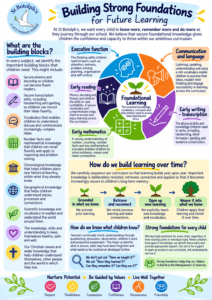
In every subject, we identify the important building blocks that children need. Teachers then deliberately revisit and build upon these as children move through St Botolph’s.
This might include:
- secure phonics and decoding so that children can become fluent readers;
- secure transcription skills, including handwriting and spelling, so that children can record their ideas fluently and increasingly automatically, freeing them to focus on the content and composition of their writing;
- vocabulary that enables children to understand, discuss and communicate increasingly complex ideas;
- number facts and mathematical knowledge that children can recall fluently and apply to reasoning and problem solving;
- chronological knowledge that helps children place new historical learning within what they already understand about the past;
- geographical knowledge that helps children understand places, processes and connections;
- scientific knowledge and vocabulary that enables children to explain and understand the world around them;
- the knowledge, skills and understanding children need to keep themselves healthy, safe and well;
- our Christian values and wider knowledge that help children understand themselves, other people and the world in which they live.
Foundational knowledge is therefore not an additional subject or programme. It runs through our entire curriculum from EYFS to Year 6.
Building Knowledge Over Time
We carefully sequence our curriculum so that learning builds year upon year. Our curriculum roadmaps show the journey children take through each subject, helping teachers to consider what children already know, what they need to learn now and how this will prepare them for what comes next.
We don’t want children simply to encounter something once and then forget it. Important knowledge is deliberately revisited, retrieved, connected and applied so that children develop increasingly rich and secure knowledge over time.
Our Curriculum at St Botolph’s ensures that:
- We activate prior learning and ensure children have the foundational knowledge they need.
- We regularly revisit previous learning and help children make connections between what they already know and what they are learning now.
- We explicitly teach new knowledge and vocabulary, model carefully, question effectively and address misconceptions.
- Children apply their learning, make connections and revisit important knowledge so that it becomes increasingly secure and can support future learning.
Over time, we want children to recognise for themselves:
“I have learned something before that can help me with this.”
Learning How to Learn
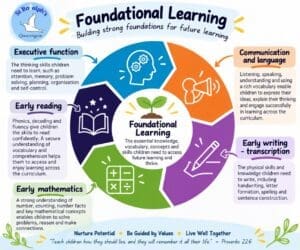
Learning is not only about what children know. Children also need to develop the thinking skills and learning behaviours that help them use what they know successfully. These are sometimes described as executive function and include skills such as paying attention, remembering instructions, organising themselves, managing emotions, solving problems and persevering when learning feels challenging.
At St Botolph’s, we explicitly teach and model these behaviours from children’s earliest days with us. Our children learn to be Ready to Look, Ready to Listen and Ready to Learn. As they grow, we support them to become increasingly independent: to maintain attention, remember and follow instructions, make thoughtful choices, ask for help when they need it, learn from mistakes and keep going when something is difficult.
We recognise that children develop these skills at different rates and may sometimes need additional support to be ready to learn. Our 4Rs – Regulate, Relate, Reason and Repair – help children to manage difficult moments, reconnect with others and return to learning successfully.
By developing these skills alongside secure knowledge, we want children to become confident, resilient and increasingly independent learners who are equipped not only for the next stage of their education, but for a lifetime of learning.
Vocabulary Matters
‘Words give children access to learning.’
A rich and growing vocabulary helps children to understand what they hear and read, express their ideas, ask questions and explain their thinking.
Across our curriculum, we deliberately identify and teach important vocabulary. Children hear adults model new words accurately, explore what they mean and have frequent opportunities to use them through speaking, reading and writing.
As children move through St Botolph’s, their vocabulary grows alongside their knowledge, enabling them to think and communicate with increasing precision, confidence and independence.
Strong Foundations for Every Child
Every child arrives at new learning with different experiences, knowledge and understanding. Our ambition is high for every child at St Botolph’s, regardless of their starting point or individual need.
Teachers continually find out what children know and understand through questioning, discussion, observation, children’s work and purposeful assessment. This helps us identify what is secure, what may have been forgotten, where misconceptions exist and what needs to be revisited or developed further. Teaching can then respond to what children actually know rather than simply moving on because something has been taught.
Where children have gaps in the foundational knowledge they need for future learning, we identify these as early as possible and provide appropriate teaching and support. For children with SEND, this may include scaffolding, reasonable adjustments or targeted intervention, while maintaining high expectations and ambition.
Our aim is for support to open up access to our curriculum, enabling every child to build secure foundations and become an increasingly confident and independent learner.
Building Foundations from the Very Beginning
In EYFS, we begin laying the foundations for all future learning. Through a carefully planned balance of adult-led, adult-initiated and child-led learning, children develop the communication, early reading, writing and mathematical knowledge and skills that they will continue to build upon throughout their time at St Botolph’s.
Our youngest children also begin to develop the executive function skills and learning behaviours that help them become successful learners. Through purposeful play, routines, interactions and carefully planned experiences, children learn to listen and focus, remember instructions, communicate their ideas, make choices, solve problems, manage their emotions and persevere when something is challenging. They are encouraged to be curious, explore, ask questions, make connections, collaborate with others and increasingly take responsibility for their own learning.
These early experiences are carefully built upon as children move through Key Stage 1 and Key Stage 2. By giving children strong foundations from their very first days at St Botolph’s, we help them develop the confidence, independence and love of learning they need to thrive within our ambitious curriculum.
Strong Foundations through our Curriculum
As children journey through St Botolph’s, their learning continually builds upon what has come before. Knowledge does not sit in separate boxes; children are encouraged to make connections, draw upon previous learning and use what they know to understand increasingly complex ideas.
Our subject leaders carefully identify the important knowledge, vocabulary, concepts and skills that children need in order to be successful in each area of the curriculum. Through our curriculum roadmaps, progression documents and carefully sequenced teaching, we ensure that learning builds purposefully from EYFS to Year 6 and prepares children for what comes next.
For us, curriculum success is not simply about whether something has been taught. We continually ask:
Have they learned it? Can they remember it? Can they use it?
This reflects our wider vision for every child at St Botolph’s. We Nurture Potential by ensuring every child develops the strong foundations they need to flourish. We are Guided by Values as children learn to persevere, work alongside others with friendship and respect, and demonstrate compassion, thankfulness and truthfulness. We Live Well Together by creating an inclusive community where every child belongs, participates and is supported to succeed.
“Teach children how they should live, and they will remember it all their life.” – Proverbs 22:6
Ultimately, our ambition goes far beyond children simply remembering facts. We want them to leave St Botolph’s with rich knowledge, strong learning habits, confidence, curiosity and a genuine love of learning. We want them to make connections, ask thoughtful questions, understand themselves and the world around them, and feel excited and well prepared for whatever they learn next.
Strong foundations today help our children to flourish as the lifelong learners of tomorrow.