Design and Technology

Welcome to the Design and Technology page

D.T Lead: Mrs Eames

D.T Governor: Mr Newham

We are very enthusiastic about D.T at St Botolphs School. There are so many exciting projects that the children carry out in every year group. We are also really looking forward to our D.T and Art Day linked to Lincolnshire Day, where the children will work in different year groups to create amazing products centred around key features of our county.

Intent

At St Botolphs Primary, we encourage children to use their creativity and imagination, to design and make products that solve real and relevant problems within a variety of contexts. Design and Technology is a practical subject and it encourages children to learn to think creatively to solve problems both as individuals and as members of a team. The aim is for products to be researched and explored beforehand and made with a purpose. Individuality should be encouraged. As a school, we aim to make Design and Technology a cross curricular subject, linking it to Maths, English, History, Science, Computing and Art.
Implementation

The teaching of Design and Technology through the school follows the National Curriculum and the Chris Quigley progression of skills document. The progression of skills is divided into 3 milestones, that spread over a 2 year period. These cover food, textiles, materials, construction and electronics. Each milestone builds on the previous one. At the start of the Design Technology area of learning, children will be given the opportunity to research products and famous designers/architects. They will pull strands from that research, to create their own products. During the planning process, computing will be used to develop ideas, particularly in KS2. As well as working individually to develop their own learning, children will be asked to work collaboratively. This will enable collective problem solving. During the “making” phase, children will be encouraged to make on-going changes and improvements.

Early Years Foundation Stage

During the EYFS, pupils explore and use a variety of media and materials through a combination of child initiated and adult directed activities.

They have the opportunities to learn to:

  • Use different media and materials to express their own ideas
  • Use what they have learnt about media and materials in original ways, thinking about form, function and purpose
  • Make plans and construct with a purpose in mind using a variety of resources
  • Develop skills to use simple tools and techniques appropriately, effectively and safely
  • Select appropriate resources for a product and adapt their work where necessary
  • Cook and prepare food adhering to good health and hygiene routines

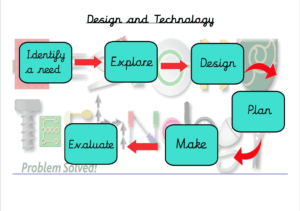
Planning Phase for creating DT products

Research

Before making a product, always include research of products. Are there history links that can be made? Can you find a famous designer/architect/engineer?

In connection with food, research the sources of the ingredients.

Exploration

Find real life examples or pictures of the products, for the children to examine and evaluate. This will help to promote ideas for their product.

Design

Generate designs and think about possible materials and techniques required to make the product. Include measurements where required.

A final design will be selected and refined.

Making

The children will select their materials and equipment in order to create their product.

Evaluate and Improve

Throughout the whole process, the children should be encouraged to study their design and decide on any necessary changes and adaptations required, that will improve the product.

Computing

Use technology, where appropriate to aid the design process. For Milestone 1, See-Saw should be used. In Year 4, Makey Makey will be used. Year 6 will use Microbits.

Impact

Children will have clear enjoyment and confidence in design and technology that they will then apply to other areas of the curriculum. They will ultimately know more, remember more and understand more about Design Technology, demonstrating this knowledge when using tools or skills in other areas of the curriculum and in opportunities out of school. The large majority of children will achieve age related expectations in Design Technology. As designers, children will develop skills and attributes they can use beyond school and into adulthood.

DT Co-coordinator: Mrs Eames
Governor: Mr Newham

Pupil Voice

Do you like DT?

“Yes it’s great fun, as I get to make exciting things.” (Y2)

How do you know when you’ve made a good product?

“When you’ve met the design criteria and you’re proud of it.” (Y6)

DT Day 2026

We celebrated Lincolnshire Day by going lots of creative activities, based on The Red Arrows, Heckington Windmill, Lincoln Cathedral, Donna Nook and preparing yellowbelly snacks.

DT Day Photos

EYFS Sleds

EYFS Sleds [PDF]

DT Projects

Dt Projects [PDF]

Learning at home

Junk Modelling
  • Save empty cardboard boxes, plastic bottles, and kitchen roll tubes.
  • Challenge your child to build a bridge, a tower, or a vehicle.
  • Practice joining materials together using tape, glue, or split pins.
  • Plan the design on paper before building starts.
Cooking and Food Preparation
  • Involve children in measuring and weighing ingredients for meals.
  • Talk about where different foods come from and how they grow.
  • Discuss how heat changes the texture and taste of food during baking.
  • Design a new sandwich or pizza topping combination.
Sewing and Textiles
  • Practice threading large plastic needles with thick wool.
  • Try simple running stitches on pieces of scrap fabric.
  • Cut out templates from paper and pin them to cloth.
  • Make a simple felt bookmark.
Exploring How Things Work
  • Look at everyday household objects like a peg, a zip, or a stapler.
  • Talk about why the object is shaped that way and what material it uses.
  • Examine how moving parts, wheels, or hinges work together.
  • Safely take apart a broken toy with an adult to see the inside parts.
Privacy Overview
St Botolph's Church of England Primary School

This website uses cookies so that we can provide you with the best user experience possible. Cookie information is stored in your browser and performs functions such as recognising you when you return to our website and helping our team to understand which sections of the website you find most interesting and useful.

Strictly Necessary Cookies

Strictly Necessary Cookie should be enabled at all times so that we can save your preferences for cookie settings.

Third Party Cookies

This website uses Google Analytics to collect anonymous information such as the number of visitors to the site, and the most popular pages.

Keeping this cookie enabled helps us to improve our website.